Photographing Kauai from the air
A helicopter cabin is a hard place to take a sharp picture. The airframe shakes and the light changes with every turn, and on a doors-on flight the window throws your own reflection back at you. A few settings and the right tour fix most of it, and the rest comes down to knowing when to stop shooting.
Open door or glass
The biggest decision for your pictures comes before you book. With the doors off nothing stands between the lens and the cliffs, so there is no glare and no reflected shirt in the frame. Reviewers of the Ali'i private flight mention this more than anything else and call their photos glare-free. The trade is wind and cold air, along with strict rules about what you may hold out there.
Doors-on flights have large windows, and Safari reviewers say all that glass makes taking pictures easy. The trouble is the reflections. Light inside the cabin bounces off the window, above all from a pale top or a bright phone screen, and lands as a ghost over Waimea Canyon. Our guide to doors off or doors on weighs the whole choice beyond the pictures.
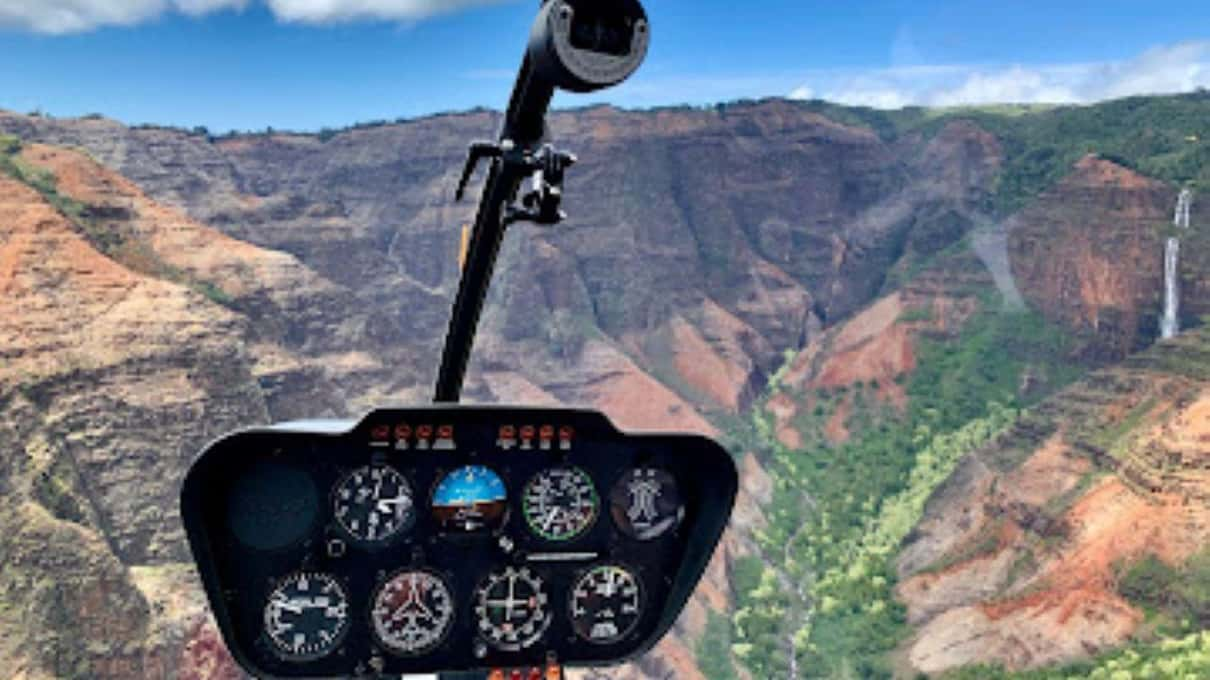
What each tour lets you carry
Camera rules differ more between operators than the routes do.
| Tour | From | Doors | Camera rule | Video |
|---|---|---|---|---|
| Ali'i private | ~$425 | Off or on, your choice | One device per person, on a strap; phone lanyards handed out | Not listed |
| Blue Hawaiian Eco Adventure | ~$449 | On | No large cameras or selfie sticks; no bags | Sold after the flight |
| Jack Harter MD500 | ~$460 | Off | Phone wrist straps provided | Not listed |
| Safari, both tours | ~$336–369 | On | No selfie sticks or bags on the landing tour | Not listed |
| Air Kauai doors-off | ~$386 | Off | A phone only, on a lanyard | Included on GetYourGuide |
Air Kauai is the strictest. Only a phone goes on board, with no other camera allowed. The crew gives out goggles and a lanyard. Ali'i allows one photo device per person, and any camera needs a strap. Jack Harter provides phone wrist straps, and its listing says nothing about larger cameras, so ask before you bring one. Blue Hawaiian's Viator listing rules out large cameras along with selfie sticks, and no bags go into the cabin, which leaves a phone or a small camera held in your hands.
Settings against the vibration
A helicopter vibrates the whole time it flies, and the shake travels through your arms into the camera. Most blurred aerial shots come from a slow shutter, not from bad focus. Set the camera up before you board, because once the crater walls appear there is no time for menus.
- A shutter speed of 1/1000 s or faster. Let the ISO climb to get there. A little grain beats a smeared cliff;
- Continuous autofocus, so the camera keeps refocusing as the helicopter moves and turns;
- Burst mode. Fire short bursts and keep the sharpest frame afterwards;
- A mid zoom. A very wide angle pulls in the window frame and the seat in front, while a long telephoto magnifies every tremor;
- Flash off. It lights up the glass and nothing beyond it;
- A lens hood, to keep stray side light off the front element.
On a phone the same ideas apply in a simpler form. Stay on the main lens rather than pinching to zoom, since digital zoom softens the picture. Hold the shutter button for a burst, and tap on the land, not the sky, so the exposure suits the cliffs.
The open-door flight for photographers
Ali'i flies only your party of two or three, so every seat sits at a window and nobody leans across you. You choose doors off or on, and lanyards are handed out at check-in.
Shooting through the window
On a doors-on flight your clothes matter as much as the camera. A dark top stops you reflecting in the glass, and Blue Hawaiian asks passengers to wear dark colors for that reason. Hold the lens close to the window but do not rest it against the pane, because the glass carries the vibration of the airframe straight into the camera.
A circular polarizing filter helps on a camera with a threaded lens. One reviewer of the Safari canyon landing tour recommends one against window reflections. Turn it on the ground until the glare drops, then leave it alone, since fiddling with a filter in a bumping cabin costs you the view.
You cannot pick your seat on a shared tour, because the crew assigns seats for weight and balance. In a six-seat cabin the rear-middle places see the least, and a photographer there shoots past other heads. Our guide to seats and weight limits explains how the seating works on each operator.
Holding on with the doors off
An open door changes the job. The airstream tugs at anything you hold out, and a phone that slips is gone for good over a canyon or the sea. Hold it in both hands with the strap round your wrist, and keep it inside the line of the door frame, where the wind is far weaker.
Air Kauai's goggles keep your eyes open into the wind. Tie long hair back, as every doors-off operator asks, or it will cross the frame in half your shots. Reviewers on the open flights say it gets cold up there, so a fitted dark jacket does two jobs, keeping you warm and keeping loose fabric out of the picture.
Light along the route
Reviewers keep saying that early flights get clearer skies, with cloud building over the mountains as the day goes on. Morning light also rakes across the fluted Na Pali ridges. Waimea Canyon is harder, because the floor can sit in deep shade while the rims glow. Expose for the sunlit walls and let the shadows go dark.
The crater of Mount Waialeale is often wrapped in cloud, so that part of every route depends on the weather on the day. When the pilot does get in, the thin white waterfalls against dark green walls fool a camera into overexposing. Dial the exposure down a little to keep detail in the falling water. When to fly over Kauai covers the weather and the hours, and what you see from the air follows the loop sight by sight.
Video packages, and putting the camera down
Some operators film the flight for you. Air Kauai's doors-off tour lists a media and photo package as included on GetYourGuide. So does the doors-on Air Kauai Ohana flight at ~$335, but that listing is new on GetYourGuide and has no reviews there yet. Blue Hawaiian sells its in-flight video after you land. What a Kauai helicopter tour costs lists the other extras.
Plenty of first-time riders spend the whole hour behind a screen and remember the flight mostly through it. Pick a couple of sights you want on camera and shoot those. Watch the rest with your own eyes. Staring at a small screen through the banking turns can also unsettle a sensitive stomach, which our guide for queasy flyers covers.
Which tour suits a photographer
For pictures we would book the Ali'i private doors-off flight at ~$425. With only your party aboard nobody sits in a middle seat, and with the doors off nothing reflects. Solo photographers pay for two seats, since it never flies with fewer than two paying guests, and children aged 7 to 11 fly doors on only, so read our page on kids and limited mobility if you travel with them.
Jack Harter's MD500 at ~$460 carries four passengers, and each one effectively sits at an open side. One left-side passenger felt the right side got the better Na Pali view. Small parties should ask Jack Harter how full the flight is, since an empty fourth seat may land on your bill. Mauna Loa's private doors-off flight at ~$384 also gives every passenger a window. A booking that comes in over its weight limit is cancelled with no money back, and you drive yourself from the check-in office to the helipad. If you would rather stay behind glass, any doors-on tour works with a dark top and a polarizer. Lihue or Princeville? explains where each of them takes off.